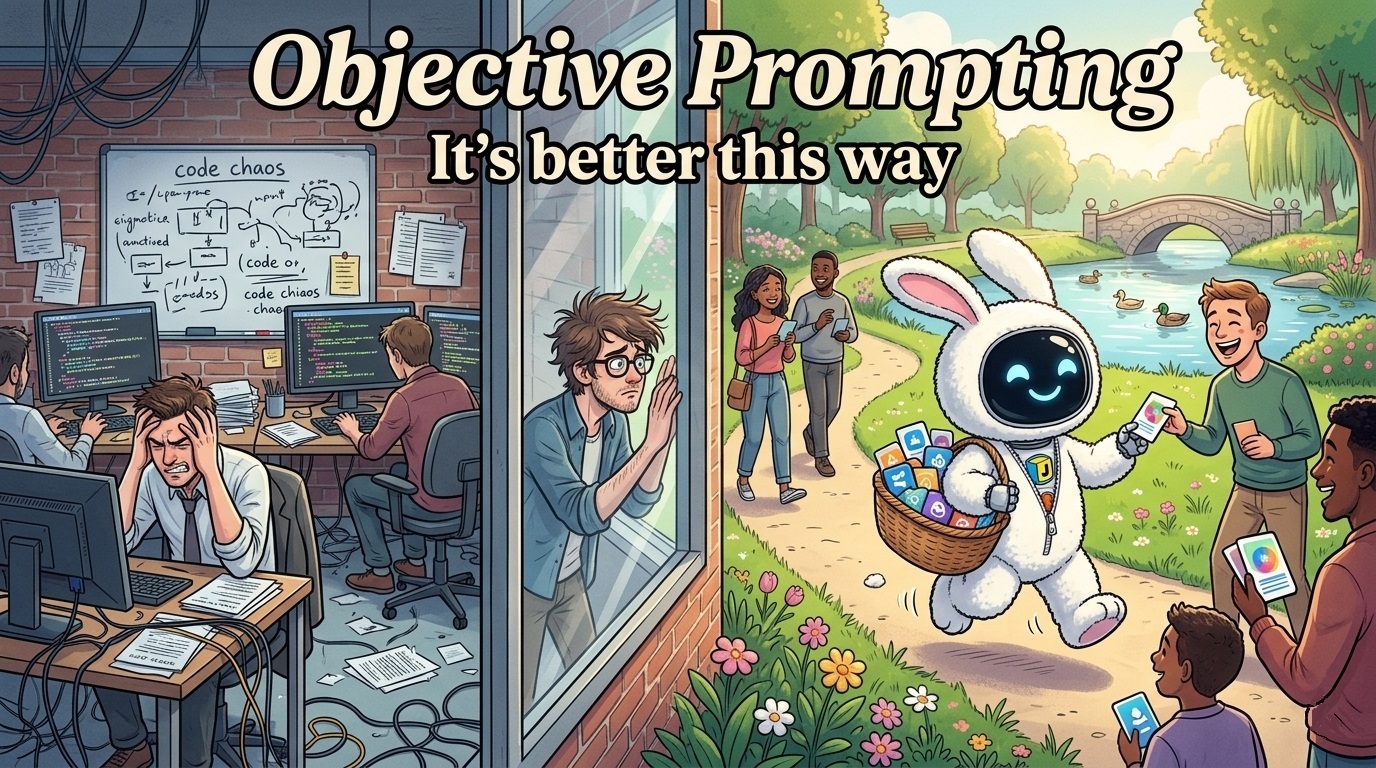
The most effective AI-assisted developers aren't the ones writing the longest prompts or debugging line-by-line. They're the ones who mastered a simple, repeatable loop: State clear objectives → Let the AI build → Test rigorously → Report precise symptoms → Iterate.
This isn't about giving the model more context every time. It's about building systems where context lives in the architecture, not in your prompts, so you can focus on direction and verification instead of constant re-explanation.
Objectives prompting turns AI from a forgetful pair-programmer into a reliable executor — when paired with durable architecture.
Everyone Adopted the Tool. Few Changed the Workflow.
92% of developers now use AI coding tools daily. 63% of "vibe coders" aren't even professional developers. Yet a third of developers report that AI often makes complex tasks harder due to missing context. The gap isn't the model — it's how we're using it.
The Amnesia Tax vs. The Objectives Loop
Traditional AI use burns time re-stating architecture, conventions, and constraints every session. Objectives prompting flips this: the architecture is documented and discoverable, so most of your effort goes into clear objectives and verification.
| Approach | Traditional Prompting | Objectives Prompting |
|---|---|---|
| Focus of most prompts | Re-explaining system & constraints | Clear objectives & desired outcomes |
| Feedback style | Line-by-line debugging | Precise symptoms + test results |
| Review burden | High — infer AI assumptions | Lower — architecture is documented |
| Who can contribute | Only those who know the full system | Anyone who can state intent clearly |
Why This Loop Wins in Practice
When architecture is stable and documented (fixed module shapes, shared conventions, clear boundaries), the AI stops guessing fundamentals. You spend time on what matters: defining success criteria, running tests, and giving surgical feedback.
This is exactly how Studio-J was built — and why new features move faster without sacrificing quality. The same principle applies to any disciplined codebase.
Build Faster with Objectives Prompting
STUDIO-J is a self-hosted platform designed around durable architecture and clear objectives — so you can direct powerful AI tools without the amnesia tax.
Explore STUDIO-JThe Future Belongs to Clear Direction + Rigorous Verification
As citizen developers grow (Gartner predicts 4:1 ratio soon), the edge goes to teams and individuals who master this loop. The model handles implementation. You handle intent and validation.
Stop managing the AI's memory. Start directing with objectives, test what matters, and ship faster.